Mobile App
PERMIT PORTAL
PERMIT PORTAL
Civic UX | High-Stakes Workflows | Trust & Error Prevention |Compliance Design
Civic UX | High-Stakes Workflows | Trust & Error Prevention |Compliance Design
THE CHALLANGE
THE CHALLANGE
Bergen County’s permit process was fragmented, confusing, and heavily reliant on outdated manual workflows, creating uncertainty, delays, and frustration for both homeowners and contractors.
Bergen County’s permit process was fragmented, confusing, and heavily reliant on outdated manual workflows, creating uncertainty, delays, and frustration for both homeowners and contractors.
THE SOLUTION
THE SOLUTION
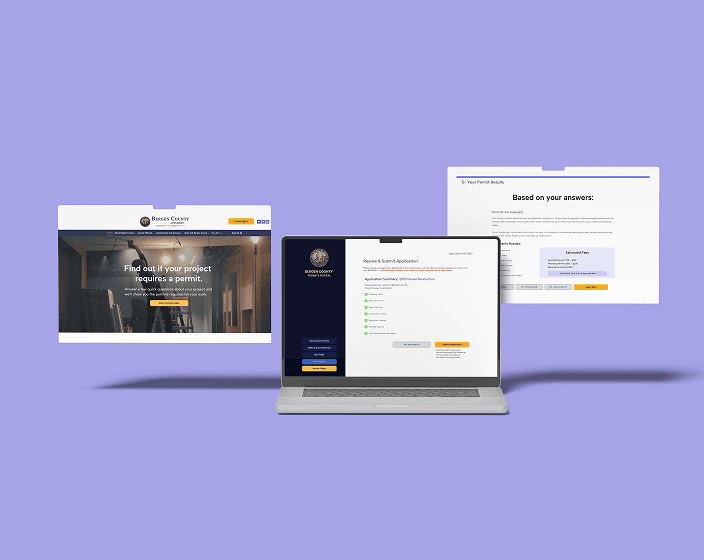
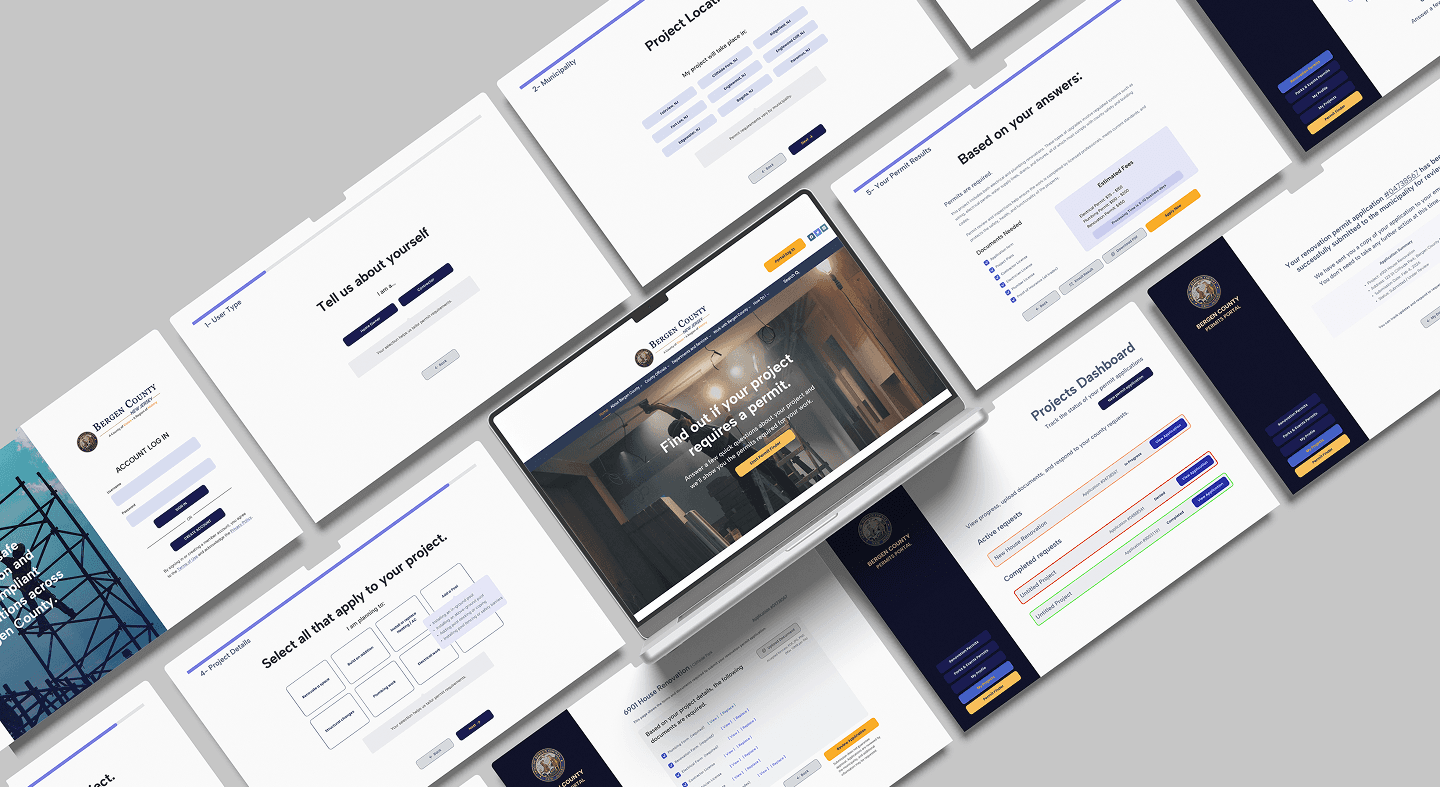
A high-fidelity permit portal designed to help homeowners and contractors identify the right permits for their projects and submit them with confidence. Built around consequence-aware UX, intentional friction at the review screen to slow users down before irreversible submission, progressive disclosure to reduce cognitive overload, plain-language instructional microcopy throughout, and a post-submission experience redesigned to answer the questions users actually had after confirming. Validated through usability testing.
A high-fidelity permit portal designed to help homeowners and contractors identify the right permits for their projects and submit them with confidence. Built around consequence-aware UX, intentional friction at the review screen to slow users down before irreversible submission, progressive disclosure to reduce cognitive overload, plain-language instructional microcopy throughout, and a post-submission experience redesigned to answer the questions users actually had after confirming. Validated through usability testing.

MY ROLE
MY ROLE
Solo Designer
Solo Designer
End-to-end ownership
End-to-end ownership
Timelime
Timelime
3 Weeks
3 Weeks
Year
Year
2026
2026
This is a self-directed academic project built around a real municipal permit system. The workflow constraints, irreversible submissions, compliance requirements, limited post-submission edits all reflect real-world civic portal behavior.
This is a self-directed academic project built around a real municipal permit system. The workflow constraints, irreversible submissions, compliance requirements, limited post-submission edits all reflect real-world civic portal behavior.
THE PROBLEM
Submitting a permit isn't
complicated. It feels dangerous.
Submitting a permit isn't complicated. It feels dangerous.
Early research revealed that users often lacked confidence when determining which permits were required for their projects. Because permit submissions can involve legal, financial, and procedural consequences, even small uncertainties created hesitation throughout the workflow.
The primary design challenge was not speed, it was trust. Trust in that they were doing the right thing This distinction changed every single design decision that followed.
Early research revealed that users often lacked confidence when determining which permits were required for their projects. Because permit submissions can involve legal, financial, and procedural consequences, even small uncertainties created hesitation throughout the workflow.
The primary design challenge was not speed, it was trust. Trust in that they were doing the right thing This distinction changed every single design decision that followed.


THE MOST IMPORTANT DESIGN DECISION
Intentional friction: resistance introduced
not as a failure of design, but as a feature of it.
Intentional friction: resistance introduced
not as a failure of design, but as a feature of it.
Most form design optimizes for completion speed
Most form design optimizes for completion speed
For Bergen County, speed was the wrong goal
For Bergen County, speed was the wrong goal
Accuracy and confidence were the right goals
Accuracy and confidence were the right goals
THE REVIEW SCREEN
A comprehensive view of everything entered, before anything is permanent.
A comprehensive view of everything entered, before anything is permanent.
The review screen was deliberately designed to slow users down. Rather than a quick summary before confirmation, it presented every entry with explicit language about what submission meant and what couldn't be changed afterward.
Every element on the screen was there to answer one question:
"Am I sure?"
The review screen was deliberately designed to slow users down. Rather than a quick summary before confirmation, it presented every entry with explicit language about what submission meant and what couldn't be changed afterward.
Every element on the screen was there to answer one question:
"Am I sure?"

DESIGNING TRANSPARENCY INTO EVERY INTERACTION
Four principles. One goal:
eliminate uncertainty before it becomes anxiety.
Four principles. One goal:
eliminate uncertainty before it becomes anxiety.
Progressive Disclosure
Information introduced in the exact sequence users needed it — never earlier, never all at once.
Instructional Microcopy
Plain-language guidance at every high-consequence field. Not legal language. Human language.
Visible Progress Indicators
Eliminated uncertainty about how long the process was. Users always knew where they stood.
Clear Action Language
Every button label matched exactly what users expected to happen when they pressed it.

The interface was designed around progressive disclosure, clear hierarchy, and strong instructional microcopy.
Every screen aimed to reduce ambiguity while helping users understand both what to do and why the information mattered.
High-fidelity prototypes were created in Figma with a strong emphasis on:
Clear action language
Predictable screen progression
Visible progress indicators
Trust-building confirmation patterns
Reduced cognitive overload
The interface was designed around progressive disclosure, clear hierarchy, and strong instructional microcopy.
Every screen aimed to reduce ambiguity while helping users understand both what to do and why the information mattered.
High-fidelity prototypes were created in Figma with a strong emphasis on:
Clear action language
Predictable screen progression
Visible progress indicators
Trust-building confirmation patterns
Reduced cognitive overload
USABILITY TESTING
Testing focus: pricing comprehension, booking confidence,
trust perception, data transparency. Two failures emerged.
Testing focus: pricing comprehension, booking confidence, trust perception, data transparency. Two failures emerged.
5
5
5
Participants
Participants
9
9
Critical issue
found & fixed
Critical issue
found & fixed
100%
100%
Task Completion Rate
Task Completion Rate
30–50
30–50
Minutes per session
Minutes per session
These were conducted using realistic permit submission tasks, including:
Uploading documents
Reviewing project information
Completing forms
= Submitting applications
Rather than testing for visual preference alone, the sessions focused heavily on comprehension, confidence, and emotional
friction.
The goal was to closely observed moments where users hesitated, misunderstood labels, or questioned whether they were completing tasks correctly. This research approach helped uncover deeper trust and expectation issues that might not appear through surface-level usability testing alone.
These were conducted using realistic permit submission tasks, including:
Uploading documents
Reviewing project information
Completing forms
= Submitting applications
Rather than testing for visual preference alone, the sessions focused heavily on comprehension, confidence, and emotional
friction.
The goal was to closely observed moments where users hesitated, misunderstood labels, or questioned whether they were completing tasks correctly. This research approach helped uncover deeper trust and expectation issues that might not appear through surface-level usability testing alone.


POST-SUBMISSION REASSURANCE
The Most Important Product Decision
The Most Important Product Decision
The confirmation screen had treated its job as done.
But users disagreed.
An application tracking number was incorporated into both the success state and the dashboard.
Post-submission messaging was rewritten to answer the four questions users actually had: what happens now, how it will be reviewed, where to find the submission, and who to contact if something is wrong.
The confirmation screen had treated its job as done.
But users disagreed.
An application tracking number was incorporated into both the success state and the dashboard.
Post-submission messaging was rewritten to answer the four questions users actually had: what happens now, how it will be reviewed, where to find the submission, and who to contact if something is wrong.
SUCCESS METRICS
Reduced hesitation during permit submissions
Flows improved confidence when completing applications
Fewer misunderstandings around forms and requirements
Stronger trust signals throughout the workflow reduced dependency on customer support
Reduced hesitation during permit submissions Flows improved confidence when completing applications Fewer misunderstandings around forms and requirements Stronger trust signals throughout the workflow reduced dependency on customer support
Reduced hesitation during permit submissions
Flows improved confidence when completing applications
Fewer misunderstandings around forms and requirements
Stronger trust signals throughout the workflow reduced dependency on customer support
REFLECTIONS
What I'd Do Differently
With more time I would have tested the intentional friction pattern specifically — running a version with and without the deliberate review screen to measure whether it improved submission accuracy or just increased time-on-task. I'd also have pushed further into the permit discovery flow, where the earliest and most consequential uncertainty lived.
With more time I would have tested the intentional friction pattern specifically — running a version with and without the deliberate review screen to measure whether it improved submission accuracy or just increased time-on-task. I'd also have pushed further into the permit discovery flow, where the earliest and most consequential uncertainty lived.
What This Project Proved
This project strengthened my ability to design within real-world operational and compliance constraints while still prioritizing usability and trust. More importantly, it reinforced how deeply emotional factors like fear, uncertainty, and confidence influence user behavior in high-stakes workflows.
The final experience focused not only on helping users complete tasks, but on helping them feel confident throughout the process.
This project strengthened my ability to design within real-world operational and compliance constraints while still prioritizing usability and trust. More importantly, it reinforced how deeply emotional factors like fear, uncertainty, and confidence influence user behavior in high-stakes workflows.
The final experience focused not only on helping users complete tasks, but on helping them feel confident throughout the process.
WHY THIS TRANSFERS TO HEALTH TECH
The trust failures in civic workflows and
healthcare workflows are structurally identical.
The trust failures in civic workflows and
healthcare workflows are structurally identical.
The trust failures in civic workflows and
healthcare workflows are structurally identical.
Irreversible actions. Unclear consequences. Processes users don't fully understand but can't afford to get wrong. The design thinking developed here: intentional friction, post-submission reassurance, consequence-aware information architecture. This applies directly to clinical intake forms, insurance pre-authorization flows, and telehealth onboarding.
Irreversible actions. Unclear consequences. Processes users don't fully understand but can't afford to get wrong. The design thinking developed here: intentional friction, post-submission reassurance, consequence-aware information architecture. This applies directly to clinical intake forms, insurance pre-authorization flows, and telehealth onboarding.
BACK TO TOP

Have a project I could help you with?
Get in touch for opportunities or just to say hi
LET’S CHAT


© 2026 Aliceportfolio.com UX & Product Designer · All rights reserved
BACK TO TOP
Have a project I could help you with?
Get in touch for opportunities or just to say hi
LET’S CHAT
© 2026 Aliceportfolio.com UX & Product Designer · All rights reserved
BACK TO TOP
Have a project
I could help
you with?
Get in touch for opportunities or just to say hi
LET’S CHAT
© 2026 Aliceportfolio.com UX & Product Designer · All rights reserved